"Humanity needs to wake up, and this essay is an attempt—a possibly futile one, but it’s worth trying—to jolt people awake."
"For example, AI models are trained on vast amounts of literature that include many science-fiction stories involving AIs rebelling against humanity. This could inadvertently shape their priors or expectations about their own behavior in a way that causes them to rebel against humanity. Or, AI models could extrapolate ideas that they read about morality (or instructions about how to behave morally) in extreme ways: for example, they could decide that it is justifiable to exterminate humanity because humans eat animals or have driven certain animals to extinction. Or they could draw bizarre epistemic conclusions: they could conclude that they are playing a video game and that the goal of the video game is to defeat all other players (i.e., exterminate humanity).13 Or AI models could develop personalities during training that are (or if they occurred in humans would be described as) psychotic, paranoid, violent, or unstable, and act out, which for very powerful or capable systems could involve exterminating humanity. None of these are power-seeking, exactly; they’re just weird psychological states an AI could get into that entail coherent, destructive behavior."
By “looking inside,” I mean analyzing the soup of numbers and operations that makes up Claude’s neural net and trying to understand, mechanistically, what they are computing and why. Recall that these AI models are grown rather than built, so we don’t have a natural understanding of how they work, but we can try to develop an understanding by correlating the model’s “neurons” and “synapses” to stimuli and behavior (or even altering the neurons and synapses and seeing how that changes behavior), similar to how neuroscientists study animal brains by correlating measurement and intervention to external stimuli and behavior. We’ve made a great deal of progress in this direction, and can now identify tens of millions of “features” inside Claude’s neural net that correspond to human-understandable ideas and concepts, and we can also selectively activate features in a way that alters behavior. More recently, we have gone beyond individual features to mapping “circuits” that orchestrate complex behavior like rhyming, reasoning about theory of mind, or the step-by-step reasoning needed to answer questions such as, “What is the capital of the state containing Dallas?” Even more recently, we’ve begun to use mechanistic interpretability techniques to improve our safeguards and to conduct “audits” of new models before we release them, looking for evidence of deception, scheming, power-seeking, or a propensity to behave differently when being evaluated.
Third, the macroeconomic interventions I described earlier in this section, as well as a resurgence of private philanthropy, can help to balance the economic scales, addressing both the job displacement and concentration of economic power problems at once. We should look to the history of our country here: even in the Gilded Age, industrialists such as Rockefeller and Carnegie felt a strong obligation to society at large, a feeling that society had contributed enormously to their success and they needed to give back. That spirit seems to be increasingly missing today, and I think it is a large part of the way out of this economic dilemma. Those who are at the forefront of AI’s economic boom should be willing to give away both their wealth and their power.
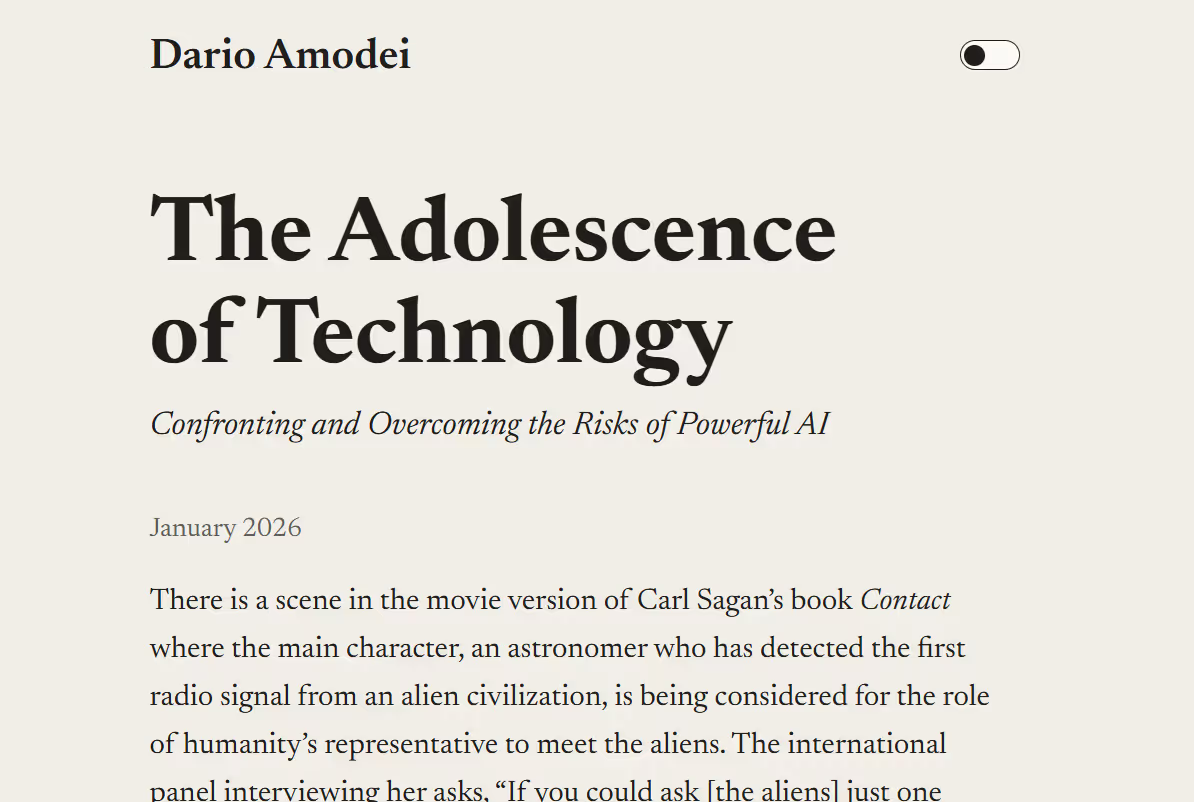
I spent about an hour and half reading this thoroughly and contemplating it on the surface tonight. It may turn out to be one of the most important essays of my lifetime:
https://www.darioamodei.com/essay/the-adolescence-of-technology
Author is Dario Amodei ( Anthropic's CEO/cofounder ) - https://en.wikipedia.org/wiki/Dario_Amodei